
Cleanroom Qualification Tests: What ISO 14644-3 Covers and in What Order
A cleanroom is qualified by a set of tests, not by a particle count alone. Airflow, filter integrity, pressure, airflow pattern and recovery all have to be proven before the classification result means anything. This guide lists the tests described in ISO 14644-3, the order they are usually run in, the occupancy state for each, and how often they are repeated.
- Classification by particle count is the last test, not the first. Airflow, filter integrity and pressure must be right before counting means anything.
- ISO 14644-3 describes the test methods; ISO 14644-1 classifies, ISO 14644-2 sets monitoring and requalification.
- Most tests are run "as built" or "at rest" during qualification; the room is then proven "in operation" with people and process running.
- ISO 14644-2 sets the maximum interval for repeating the particle classification: 6 months for ISO 5 and cleaner, 12 months for other classes.
- Each test needs a written method, calibrated instruments and acceptance criteria agreed before testing starts.
Three standards, three jobs
| Standard | What it does |
|---|---|
| ISO 14644-1 | Classifies air cleanliness by particle concentration — the ISO class. |
| ISO 14644-2 | Sets how the room is monitored to show it stays in its class, and the maximum time between classifications. |
| ISO 14644-3 | Describes the test methods: airflow, filter leak, pressure, visualisation, recovery, temperature, humidity and others. |
In a GMP facility the same tests sit inside the qualification lifecycle: design qualification of the HVAC and room layout, installation qualification of what was built, operational qualification of how it performs, and performance qualification in normal use. EU GMP Annex 1 expects cleanrooms to be qualified and requalified, with the tests and acceptance criteria justified by risk.
The test set
| Test | What it proves | Typical state |
|---|---|---|
| Airflow volume or velocity | The room receives the design supply air; in unidirectional zones, the air velocity over the work area is within range. | As built / at rest |
| Installed filter leak test | HEPA filters, gaskets and frames have no leaks after installation. | As built / at rest |
| Pressure difference | Each room holds its design pressure relative to neighbouring rooms, so air flows from cleaner to less clean areas. | At rest |
| Airflow direction and visualisation | Air moves the way the design intends, particularly over critical zones and at doors. | At rest, then in operation |
| Recovery | How quickly the room returns to its clean state after a particle challenge (100:1 recovery time). | At rest |
| Temperature and humidity | The room holds the conditions the process and people need. | At rest / in operation |
| Containment leak | Unfiltered air does not leak in from surrounding spaces through joints and penetrations. | As built / at rest |
| Particle classification | Airborne particle concentration meets the ISO class. | At rest and in operation |
The filter leak test is described in HEPA filter in-situ leak testing. Visualisation methods for isolators, which apply equally to unidirectional zones in rooms, are in airflow visualisation smoke studies.
The order that works
- Balance the HVAC first. Airflow volumes and room pressures are set by the HVAC contractor before formal testing. Testing an unbalanced system wastes the test.
- Airflow. Measure supply volumes or velocities. If they are wrong, every later result changes when they are corrected.
- Filter leak test. A leaking filter can pass a particle count on a quiet day and fail on a busy one.
- Pressure differences. With airflow fixed, confirm the pressure cascade and door alarms.
- Visualisation. Confirm airflow patterns, especially at critical zones and between rooms.
- Recovery. Measure how fast the room cleans up after a challenge.
- Particle classification at rest, then in operation with people and process present.
If any test fails, correct the cause and repeat the tests that depend on it. A change to supply airflow, for example, means repeating pressure, recovery and classification.
Occupancy states
- As built: the installation is complete and running, with no production equipment or people.
- At rest: production equipment installed and operating as agreed, but no people present.
- In operation: the room working normally, with the agreed number of people.
Agree the state for each test in the protocol. An “in operation” classification should reflect a realistic worst case — the maximum number of people and the most particle-generating activities — not a quiet shift.
How many locations and how long
The number of sampling locations for classification comes from the room area, and the sample volume from the class limit of the largest particle size considered. The ISO 14644-1 calculator works both out. For recovery, the air change and recovery time calculator gives an estimate to compare the measured value against.
Requalification
| Test | Repeat |
|---|---|
| Particle classification | ISO 14644-2: at most every 6 months for ISO 5 and cleaner, at most every 12 months for other classes |
| Other tests (airflow, filter leak, pressure, recovery, visualisation) | At intervals set by risk assessment and the site’s qualification policy |
| After a change | Repeat the tests the change can affect: filter replacement, HVAC modification, layout change, extended shutdown |
Continuous or frequent monitoring that shows the room stays in control can support the requalification decision, but it does not replace requalification.
What the report should contain
- The room, its class and the occupancy state for each test.
- Test methods with reference to ISO 14644-3 or the site procedure.
- Instrument identification and calibration status.
- Locations on a drawing, raw results and the acceptance criteria.
- Deviations, their investigation and any retests.
References
ISO 14644-1:2015, Classification of air cleanliness by particle concentration
ISO 14644-2:2015, Monitoring to provide evidence of cleanroom performance
ISO 14644-3:2019, Test methods
EU GMP Annex 1 (2022), Manufacture of Sterile Medicinal Products
Fenggu equipment for this
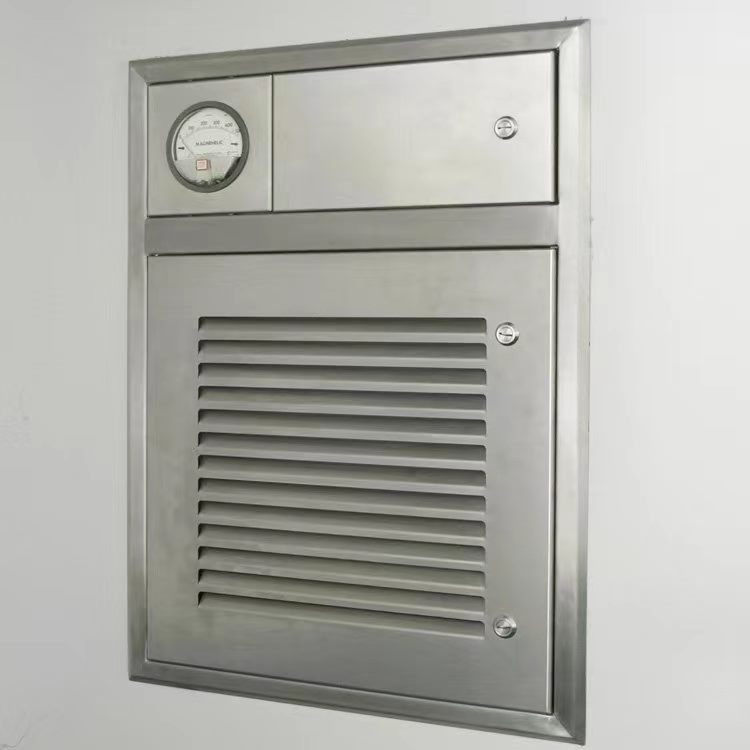
In-situ decontamination exhaust unit
Exhaust HEPA housing for containment areas, designed for safe filter change and testing in place.
View specifications →FG-VHP-C1000 / C2000HVAC-integrated VHP system
Distributes vapour through the existing AHU to treat a whole suite. Standard capacities 1,000 and 2,000 m³.
View specifications →FG-PB-VHPVHP pass box
Integrated VHP with real-time temperature, humidity, pressure and H₂O₂ concentration monitoring and printed cycle records.
View specifications →Related application guides: Cleanroom and room decontamination · HVAC-integrated VHP
Common questions
Which tests are needed to qualify a cleanroom?
Typically airflow volume or velocity, installed HEPA filter leak, pressure difference, airflow visualisation, recovery, temperature and humidity, and particle classification, with methods described in ISO 14644-3.
In what order should cleanroom tests be done?
Balance the HVAC, then airflow, filter leak test, pressure differences, airflow visualisation, recovery, and finally particle classification at rest and in operation.
How often must a cleanroom be reclassified?
ISO 14644-2 sets a maximum of 6 months for ISO 5 and cleaner and 12 months for other classes. Other tests are repeated at intervals set by risk assessment.
What is the difference between at rest and in operation?
At rest means the equipment is installed and running but no people are present. In operation means the room is working normally with the agreed number of people.
Does ISO 14644-3 set acceptance criteria?
It describes test methods. Acceptance criteria come from the classification, the design and regulatory requirements such as EU GMP Annex 1, and are fixed in the protocol.
Have a specific space or load in mind?
Send the volume, the materials and what you need to prove. An engineer replies with a recommended setup and what validation will involve.
Prefer to talk directly?
WhatsApp +86 183 2145 9135[email protected]