
Preparing a Room for VHP Decontamination: Sealing, HVAC Isolation and Placement
Most failed room decontaminations are not caused by the generator. They are caused by leaks, cold spots, blocked surfaces and indicators in the wrong places. This guide walks through how to prepare a room before a VHP cycle and what to check during and after it.
- Define the boundary first: which rooms, which ducts, and what stays outside.
- A room that leaks cannot hold concentration — seal doors, penetrations, drains and HVAC openings, then check for leaks during the cycle.
- Open, separate and raise everything inside; remove cellulose and liquids.
- Place indicators in the worst-case locations, not a convenient grid, and monitor adjacent areas.
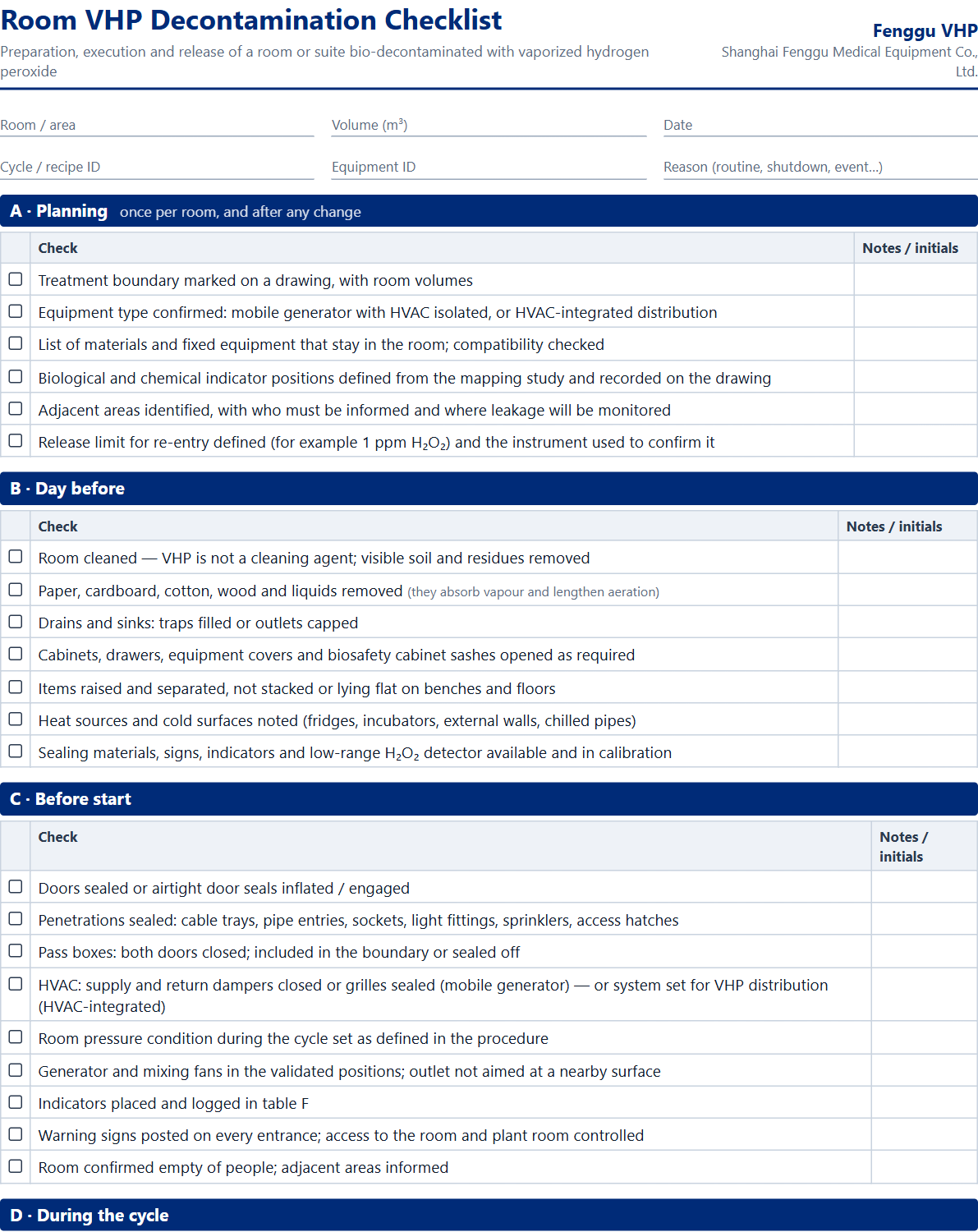 Free download: Room VHP decontamination checklist (PDF)
The checks in this guide as a printable two-page form, with an indicator log and sign-off. Get it →
1. Define the boundary
Before anything else, decide exactly what is being decontaminated. One room, or a suite? Does the air handling ductwork need treatment as well, or only the room surfaces? Which adjoining spaces will stay occupied?
The answer determines the equipment. A mobile generator treats the room with the HVAC isolated. If the ducts are part of the contamination concern, or several rooms must be treated together, an HVAC-integrated system that distributes vapour through the air handling plant is usually the better fit.
Record the boundary on a drawing, with the room volumes. Volume, together with the materials inside, is the starting point for dose and cycle design.
2. Survey what is in the room
- Remove paper, cardboard, cotton, wood and liquids — they absorb vapour and lengthen aeration. See the material compatibility guide.
- Open cabinet doors, drawers, equipment covers and biosafety cabinet sashes that should be treated.
- Separate and raise items so that surfaces are not stacked or resting flat on benches and floors.
- Clean first. VHP is not a cleaning agent. Visible soil, residues and films shield microorganisms from the vapour.
- Note heat sources and cold surfaces — fridges, incubators, external walls, chilled pipes. Cold surfaces are where condensation forms first.
3. Seal the room
A room has to hold concentration for the whole exposure phase. Leaks lower the dose at the walls and doors — often exactly where the hardest locations are — and expose people in adjacent areas.
- Doors: check gaskets; tape the perimeter of doors that are not airtight. Airtight doors with inflatable or mechanical seals remove the need for taping.
- Penetrations: cable trays, pipe entries, sockets, ceiling light fittings, sprinkler heads and access hatches.
- Drains and sinks: fill traps or cap the outlets.
- Pass-throughs: close both doors and include the pass box in the boundary or seal it off.
- HVAC: with a mobile generator, close supply and return dampers or seal the grilles, so vapour is neither exhausted nor carried into other zones. Plan how the HVAC will be restored for aeration.
Decide whether the room is held at neutral pressure or slightly negative to its surroundings during the cycle, and make the decision part of the procedure. Outward leakage is a safety issue, not only an efficacy issue.
4. Place the generator and fans
- Put a mobile generator where its output can mix with the whole room, usually near the centre, and never aimed directly at a nearby surface — a concentrated jet on a cold surface is a condensation point.
- Use mixing fans to move vapour into corners, behind equipment and into alcoves. Fan positions are part of the cycle and should be fixed in the procedure once validated.
- Keep the generator’s own sensors and cables clear of doors and seals.
5. Sensors and indicators
Hydrogen peroxide concentration, relative humidity and temperature should be monitored at representative points, including at least one location expected to be worst case. Biological indicators (BIs) and chemical indicators (CIs) go where the vapour is least likely to reach the required dose:
- Corners at floor and ceiling level, and the corners furthest from the generator.
- Behind and underneath fixed equipment, inside cabinets and equipment housings.
- Near the door and near any sealed opening where leakage would dilute the vapour.
- Next to absorbent materials that could not be removed, and on cold surfaces.
The number and positions come from the mapping study for the room. Once validated, the same positions are used for routine monitoring and periodic requalification, so record them on the room drawing.
6. Safety before, during and after
- Post warning signs on every entrance and control access to the room and the plant room serving it.
- Monitor adjacent areas and door seals for leakage during exposure, using a low-range detector.
- Define who can stop the cycle and how, and what happens if a leak is detected.
- Release the room only after a documented reading at or below the limit — see aeration and residual limits.
Checklist
| When | Check |
|---|---|
| Planning | Boundary drawing and volumes · material list · equipment type confirmed · BI/CI positions defined · adjacent areas identified |
| Day before | Room cleaned · cellulose and liquids removed · drains capped · cabinets and drawers open · items raised and separated |
| Before start | Doors and penetrations sealed · HVAC dampers closed or grilles sealed · generator and fans in validated positions · indicators placed and logged · signs posted · room empty |
| During | Concentration, RH and temperature trending as expected · adjacent areas and door seals checked for leakage · no condensation alarms |
| After | Aeration to limit · release reading recorded · seals and tape removed · HVAC restored · indicators retrieved and sent for incubation · cycle record signed |
References
ISO 22441:2022 — Low temperature vaporized hydrogen peroxide sterilization
EU GMP Annex 1 (2022), Manufacture of Sterile Medicinal Products
PDA Technical Report No. 51, Biological Indicators for Gas and Vapor-Phase Decontamination Processes
Fenggu equipment for this
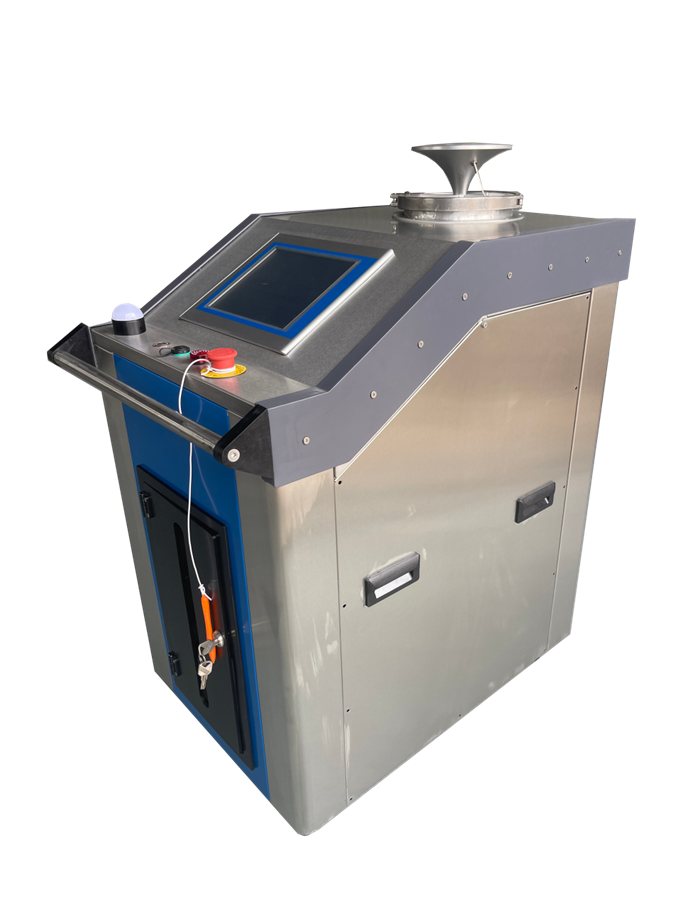
Mobile VHP room sterilizer
Wheeled unit for spaces up to 300 m³, with scheduled and remote start.
View specifications →FG-VHP-C1000 / C2000HVAC-integrated VHP system
For suites and ductwork: a fixed system that distributes vapour through the existing AHU.
View specifications →Airtight doorsInflatable-seal airtight door
Removes the need to tape doors on rooms that are decontaminated routinely.
View specifications →Related application guides: Cleanroom and room decontamination · Biosafety laboratory decontamination
Common questions
Do I need to switch off and seal the HVAC for room VHP decontamination?
With a mobile generator, yes: close the supply and return dampers or seal the grilles so vapour is not exhausted or carried into other zones, then restore the HVAC for aeration. With an HVAC-integrated system the air handling plant is used to distribute the vapour, so the approach is different.
What should be removed from a room before VHP?
Paper, cardboard, cotton, wood and liquids, because they absorb hydrogen peroxide and lengthen aeration. Everything else that needs treatment should be cleaned, opened and separated so the vapour can reach its surfaces.
How many biological indicators are needed for a room?
The number and positions come from the mapping study for that room and are justified by its size, layout and worst-case locations. Once validated, the same positions are used for routine monitoring and requalification.
Where should biological indicators be placed?
In the locations the vapour is least likely to reach at full dose: far corners at floor and ceiling level, behind and under fixed equipment, inside cabinets, near doors and seals, near absorbent materials and on cold surfaces.
Should mixing fans be used with a mobile VHP generator?
In most rooms, yes. Fans help vapour reach corners and spaces behind equipment and reduce the risk of local condensation. Their positions should be fixed during cycle development and kept the same for routine cycles.
Have a specific space or load in mind?
Send the volume, the materials and what you need to prove. An engineer replies with a recommended setup and what validation will involve.