
Isolator Glove Integrity Testing: Methods, Frequency and What to Do After a Breach
Gloves and sleeves are the thinnest, most-handled part of an isolator barrier and the most likely place for it to fail. This guide covers how gloves are tested, how often, how the VHP cycle affects them, and how to respond when one fails.
- Gloves are the weakest point of the barrier: thin elastomer, flexed constantly, and in contact with sharp edges and tools.
- Use two complementary checks: visual and tactile inspection every time a glove is used, and a physical leak test (usually pressure decay) at defined intervals.
- EU GMP Annex 1 (2022) expects glove integrity testing at least at the beginning and end of each batch or campaign, with frequency justified by risk.
- During VHP, gloves must be extended so folds are exposed; elastomers also absorb peroxide and slowly degrade, which affects aeration and change intervals.
- A failed glove triggers a documented impact assessment on the batch, not just a glove change.
Why gloves deserve their own programme
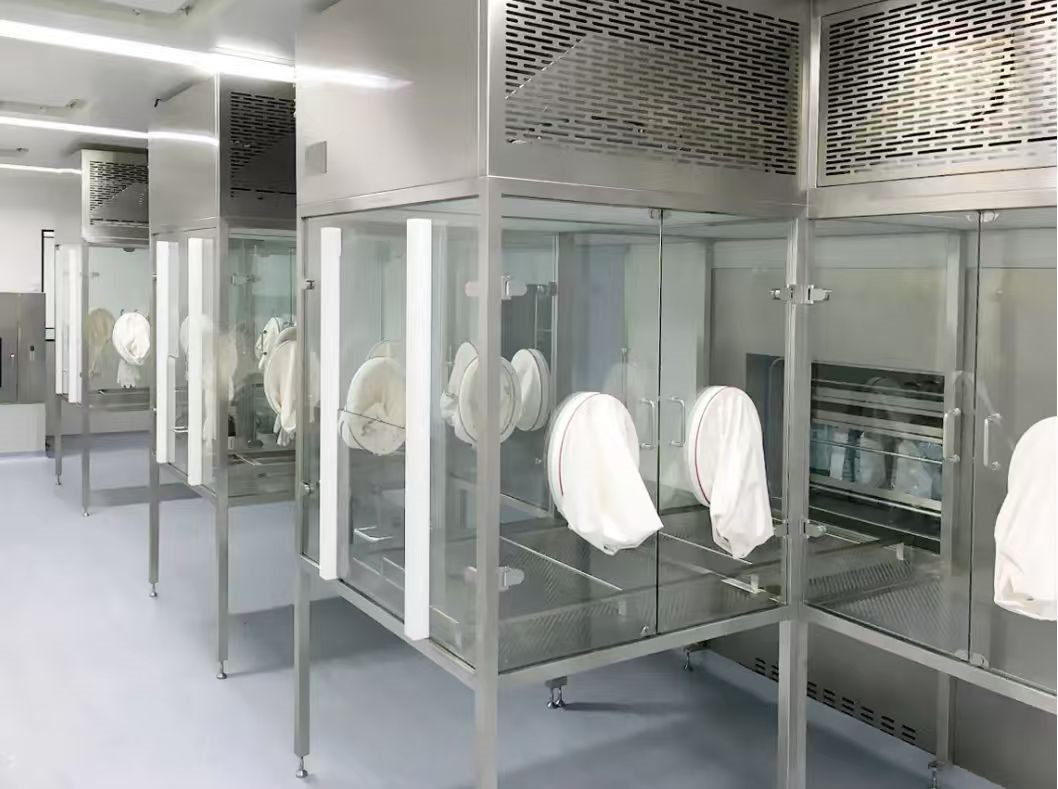
An isolator shell is stainless steel and glass; its weakest points are the parts made of rubber. A glove is typically well under a millimetre thick, is stretched and flexed hundreds of times a shift, and touches stopper bowls, tools and the edges of components. A pinhole or a split seam turns a closed barrier into an open one, and in an aseptic process the operator’s hand is the most likely contamination source there is.
For that reason regulators treat the glove system — glove, sleeve, cuff ring and glove port — as a critical part of the barrier, with its own inspection, testing and replacement regime. The same applies to RABS gloves and to half-suits where they are used.
What fails, and where
| Failure | Typical cause | Where to look |
|---|---|---|
| Pinholes | Puncture from sharp components, tool tips, glass | Fingertips, especially thumb and index finger |
| Tears and splits | Abrasion, overstretching, ageing of the elastomer | Between fingers, palm, cuff area |
| Thinning and cracking | Cumulative chemical exposure (disinfectants, H₂O₂), ozone, UV | Folds and creases, sleeve bends |
| Leaks at the connection | Worn O-rings, incorrect fitting after a change | Glove-to-sleeve and sleeve-to-port rings |
Common glove materials include chlorosulfonated polyethylene (CSM), neoprene, butyl, polyurethane and EPDM-based blends, often as multi-layer constructions. Each has a different balance of dexterity, chemical resistance, permeation and resistance to hydrogen peroxide, which is why the glove specification belongs in the isolator URS.
How gloves are tested
Visual and tactile inspection
Before and after each use, the operator inspects the glove for discolouration, stickiness, thinning, cuts and pinholes, with particular attention to the fingertips. Stretching the glove gently under good lighting makes small defects easier to see. This catches damage immediately, but it is subjective and will miss small pinholes.
Pressure decay testing
The most widely used physical test. The glove port is closed from the outside with a test cap, the glove is inflated to a defined test pressure, and after a stabilisation period the pressure drop over a fixed time is measured. If the drop exceeds the limit, the glove fails. Portable and wireless glove testers make it practical to test every port without breaking the isolator’s integrity.
Pressure decay has a detection limit: very small holes may not cause a measurable drop within the test time, and results are sensitive to temperature changes and to the glove stretching during the test. The limit, stabilisation time and test time should therefore be set during qualification, ideally using gloves with calibrated artificial defects, and the method should be combined with visual inspection rather than relied on alone.
Other methods
Some facilities supplement pressure decay with tracer-gas methods or with microbial challenge studies during qualification, to show that a defect of the size the routine test can detect is the size that matters. These are qualification tools rather than routine checks.
How often to test and change gloves
EU GMP Annex 1 (2022) expects gloves to be visually checked whenever they are used and the glove system to be integrity tested at defined intervals — at a minimum at the beginning and end of each batch or campaign — with additional testing where the campaign length or risk justifies it. A practical programme looks like this:
| Activity | Typical frequency |
|---|---|
| Visual and tactile inspection | Before and after each use; after any intervention involving sharp items |
| Physical leak test | At least before and after each batch or campaign; after each glove change |
| Fingertip microbial sampling | At the end of aseptic operations and after critical interventions, per the EM programme |
| Glove replacement | At a fixed interval justified by usage and failure data, and whenever a glove fails or is damaged |
| Sleeve and O-ring replacement | Longer interval than gloves, based on inspection and trend data |
Replacement intervals should come from data rather than habit. Trending failures by port position, shift and operation quickly shows which ports or tasks wear gloves fastest — useful both for adjusting intervals and for redesigning the task or the ergonomics.
Gloves are normally changed with a push-through technique on the port ring, so the new glove is fitted before the old one is removed and the barrier is never opened. After a change, the new glove is leak tested and the isolator is decontaminated before aseptic use, according to the site’s procedure.
Gloves and the VHP cycle
Gloves interact with hydrogen peroxide decontamination in three ways that matter in practice.
- Exposure of folds. A glove hanging limp has creases and finger surfaces the vapour reaches poorly. During the cycle, gloves are held extended — typically on glove stands or by slight overpressure — in the same configuration used during cycle development. Biological indicators are often placed at glove fingertips during qualification because they are a recognised worst case.
- Absorption and aeration. Elastomers absorb hydrogen peroxide and release it slowly. A full set of gloves and sleeves can be a major contributor to aeration time and to the residual peroxide level inside the isolator at the start of filling. See VHP aeration and residual H₂O₂.
- Ageing. Repeated oxidation gradually changes the elastomer. Glove suppliers can state compatibility with H₂O₂, but the change interval should still be confirmed from the site’s own cycle frequency and failure trend.
When a glove fails
- Stop and protect. Stop using the port, keep the glove in place for investigation if it can be done safely, and record time, port and the operations performed since the last pass.
- Assess the impact. Was the failure found before, during or after aseptic operations? Was the defect in a location that contacted critical surfaces? What do the fingertip samples and EM data show? The batch disposition decision comes from this assessment.
- Find the cause. Inspect the defect: puncture, abrasion or ageing. Check the task, the tool, the component and the glove’s age.
- Replace and retest. Change the glove, leak test it and decontaminate before returning the isolator to aseptic use.
- Trend. Add the event to the glove failure trend so repeated failures at the same port or step are visible.
Isolator gloves are one part of barrier integrity; the enclosure itself is checked separately by a leak test of the whole isolator — see isolator leak testing by pressure decay on our main site.
References
EU GMP Annex 1 (2022), Manufacture of Sterile Medicinal Products
ISO 14644-7, Cleanrooms and associated controlled environments — Separative devices
PDA Technical Report No. 34, Design and Validation of Isolator Systems for the Manufacturing and Testing of Health Care Products
PIC/S PI 014, Isolators used for Aseptic Processing and Sterility Testing
Fenggu equipment for this
Aseptic filling isolator
Integrated VHP bio-decontaminates exposed interior surfaces before every campaign; unidirectional airflow, H14 HEPA, pressure and particle monitoring.
View specifications →FG-ISO-STSterility test isolator
Reserved VHP generator port to decontaminate the chamber and exposed surfaces before testing, reducing false positives.
View specifications →FG-ISO-CCCell processing isolator
Dry VHP decontamination between processes, with temperature control during the cycle to protect cell viability.
View specifications →Related application guides: Isolator and RABS decontamination · Cell and gene therapy
Common questions
How often should isolator gloves be leak tested?
EU GMP Annex 1 (2022) expects the glove system to be integrity tested at a minimum at the beginning and end of each batch or campaign, with additional tests where the campaign length or risk justifies it. Gloves are also visually inspected every time they are used and leak tested after every glove change.
What is pressure decay glove testing?
The glove port is closed with a test cap, the glove is inflated to a defined pressure, and the pressure drop over a fixed time is measured after a stabilisation period. A drop larger than the qualified limit means the glove fails.
Can a pressure decay test detect every pinhole?
No. Every method has a detection limit, and very small holes may not produce a measurable drop within the test time. That is why visual and tactile inspection is kept alongside the physical test, and why the test parameters are qualified using gloves with known defects.
How often should isolator gloves be replaced?
At an interval justified by usage and failure data for the site, and immediately whenever a glove fails a test or is visibly damaged. Sleeves and O-rings usually have longer intervals than gloves.
Why are gloves extended during VHP decontamination?
A slack glove has folds and finger surfaces that the vapour reaches poorly. Holding gloves extended exposes these surfaces; the configuration used in routine cycles must match the one used during cycle development and qualification.
Have a specific space or load in mind?
Send the volume, the materials and what you need to prove. An engineer replies with a recommended setup and what validation will involve.