
VHP Bio-decontamination for Isolators and RABS
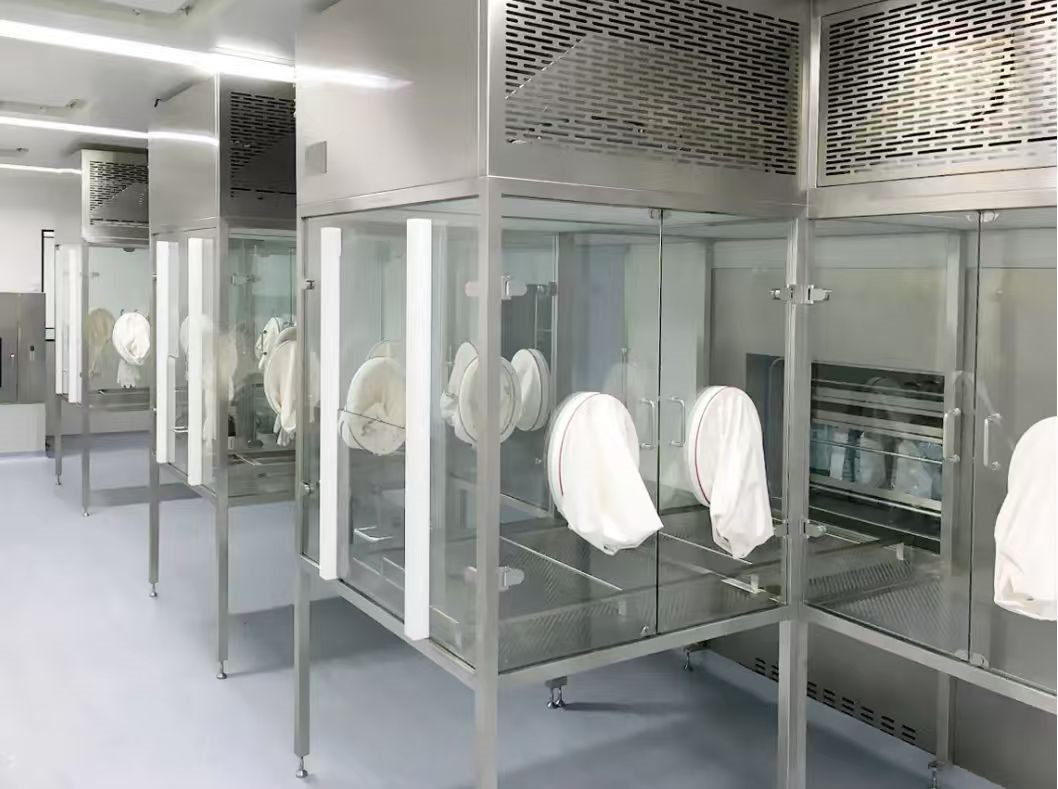
An isolator is only as good as the decontamination step that starts each campaign. Integrated or connected VHP brings the closed chamber, gloves and exposed surfaces to a validated state before product is exposed.
Why this needs a VHP step
Because the isolator is a sealed, small volume, it can be decontaminated reproducibly — far more reliably than a room. That reproducibility is what lets isolators sit in a lower-grade background while protecting a Grade A interior.
The difficulties are the details: glove fingers, mated surfaces, transfer ports and materials inside the chamber, and getting residual peroxide down to a level that will not affect the product.
Equipment options
Aseptic filling isolator
Integrated VHP biodecontaminates exposed interior surfaces before every campaign; unidirectional airflow, H14 HEPA, pressure and particle monitoring.
View specifications →FG-ISO-STSterility test isolator
Reserved VHP generator port to decontaminate the chamber and exposed surfaces before testing, reducing false positives.
View specifications →FG-ISO-CCCell processing isolator
Dry VHP decontamination between processes, with temperature control during the cycle to protect cell viability.
View specifications →What to plan for
Integrated or connected?
Integrated generators give the shortest, most repeatable cycles and fixed piping. A port for an external generator costs less and suits sterility-test or low-frequency use. Decide based on how often you decontaminate.
Gloves and ports are the worst cases
Glove fingers, folds, door gaskets and transfer-port seals are where VHP contact is weakest. Stretch gloves during the cycle and put biological indicators there during qualification.
Load inside the chamber
Anything left inside — tools, consumables, components — becomes part of the validated load. Absorbent plastics and filters take up peroxide and lengthen aeration.
Residuals and the product
Some products, especially biologics and cell cultures, are sensitive to low levels of residual H₂O₂. Set the aeration end-point from product risk, not just operator safety.
Leak test before gassing
A pressure-decay leak test before each cycle confirms the chamber is tight, both for decontamination performance and for operator protection.
Information an engineer will need
Having these ready makes the first recommendation specific instead of generic.
- Isolator type and process (filling, sterility test, cell processing)
- Chamber volume and number of glove ports
- Positive or negative pressure
- Decontamination frequency
- Product sensitivity to residual peroxide
- Transfer devices (RTP, pass box) connected
Common questions
Can a RABS be decontaminated with VHP?
A closed RABS can be gassed with doors shut; an open RABS (oRABS) is normally decontaminated together with the surrounding room, for example with a mobile generator or an HVAC-integrated system.
How long does an isolator VHP cycle take?
It depends on volume, load, materials and the residual end-point. Aeration usually dominates. The cycle time is fixed during cycle development for the specific isolator and load.
Is VHP decontamination the same as sterilisation?
VHP in an isolator is a surface bio-decontamination step, qualified as a ≥ 6-log sporicidal reduction. Product-contact items are normally sterilised separately and brought in through validated transfers.
Tell us about your application
Send the volume, materials and what you need to achieve. An engineer reviews it and replies with a recommended setup and what validation will involve.