
How to Write an Isolator URS: Sections, Example Requirements and Common Gaps
The user requirement specification is the document every later test is measured against. A vague URS produces an isolator that meets the letter of the specification and still does not suit the process. This guide gives a section-by-section structure, examples of testable requirements, and the gaps that most often cause trouble at FAT.
- A URS states what the process needs, not how the supplier should build it — and each requirement must be testable.
- Number every requirement and mark its priority, so it can be traced to design, FAT, SAT and qualification.
- Product sensitivity to hydrogen peroxide and the residual target belong in the URS, not in a later discussion.
- Specify leak tightness as a class plus a test method and pressure; a number alone cannot be verified.
- The most expensive gaps are usually ergonomics, transfers and data integrity, not the chamber itself.
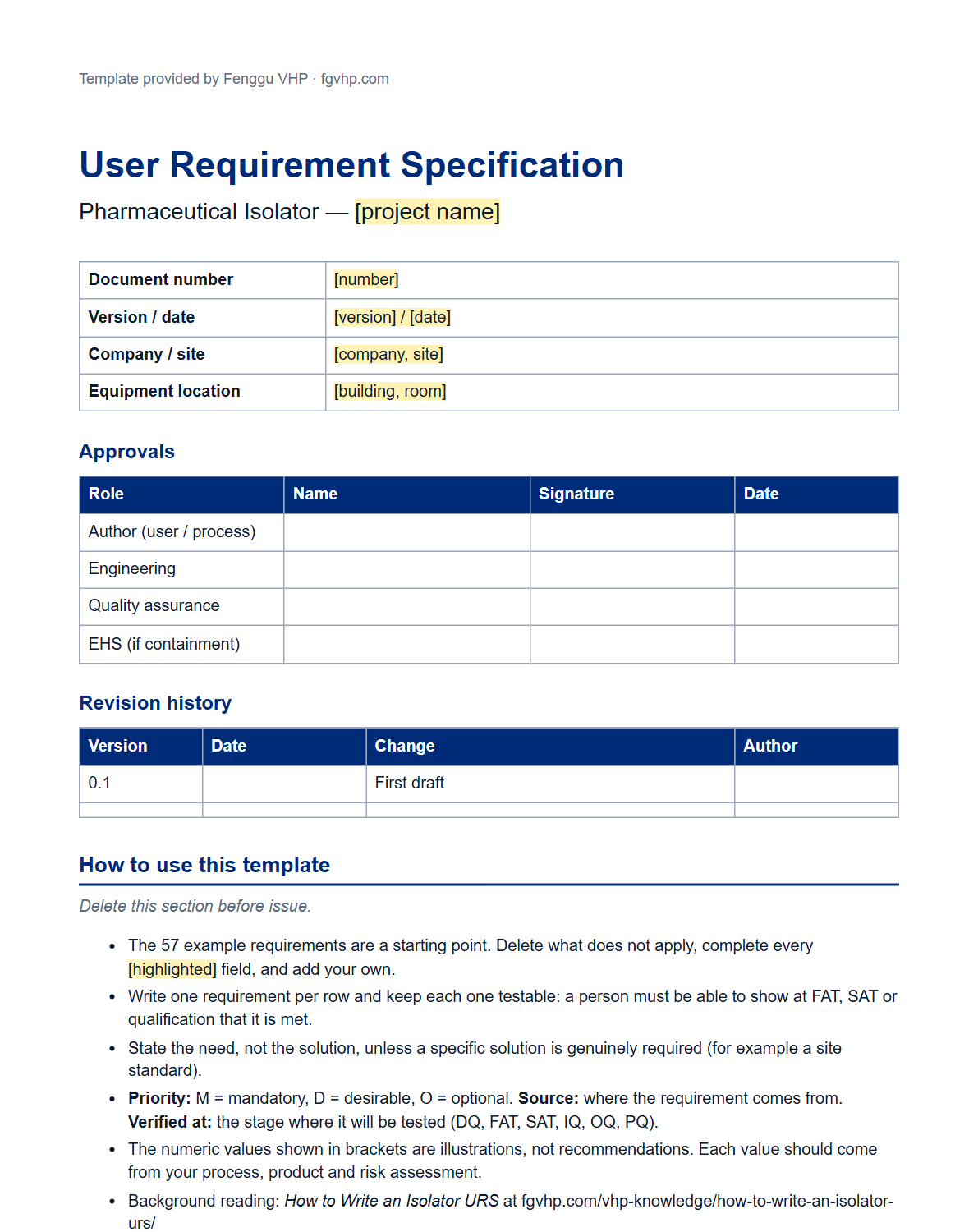 Free download: Isolator URS template (Word)
12 sections and 57 example requirements with IDs, priority and verification stage — ready to edit. Get it →
What a URS is for
The user requirement specification (URS) records what the user needs the isolator to do, in terms that can later be verified. The supplier answers it with a functional and design specification; design qualification checks that the design meets it; FAT, SAT, IQ, OQ and PQ test against it. If a need is not in the URS, there is no obligation to meet it and no test that will catch its absence.
Rules for writing requirements
- One requirement per statement, numbered (for example URS-4.3), so it can be traced.
- Testable. “The isolator shall be easy to clean” cannot be verified. “All product-contact surfaces shall be 316L stainless steel with Ra ≤ 0.4 µm” can.
- Need, not solution. State the result you need — cycle time, residual level, containment — and let the supplier propose how. Specify a solution only where it is genuinely a requirement (for example a site standard PLC).
- Priority. Mark each requirement as mandatory, desirable or optional. It keeps quotations comparable and decisions honest.
- Source. Note where a requirement comes from: regulation, product, site standard, or operator input.
Section-by-section structure
| Section | What to include |
|---|---|
| 1. Scope and process | What the isolator is for, process steps inside it, products, container formats, batch sizes, speed, campaign length, number of shifts |
| 2. Protection concept | Product protection, operator protection or both; positive or negative pressure; OEB or occupational exposure limit if handling potent compounds; background room grade |
| 3. Air and pressure | Grade inside the critical zone, unidirectional or turbulent flow, air velocity at working height, pressure differential to the room, alarm and recovery behaviour |
| 4. Leak tightness | Required ISO 10648-2 class with test method, test pressure and frequency (for example before every VHP cycle) |
| 5. Bio-decontamination | Integrated or external VHP; cycle time target; efficacy (6-log reduction on biological indicators at all locations); residual H₂O₂ target at the start of production; aeration time; product sensitivity to peroxide |
| 6. Transfers | Every material flow in and out: components, tools, EM media, waste, product. Transfer devices (transfer ports, pass box, airlock), sizes and frequencies |
| 7. Ergonomics | Glove port positions and heights for the actual operator population, reach to every point that must be touched, visibility, a mock-up review before design freeze |
| 8. Materials and construction | Material of construction, surface finish, gasket and glove materials compatible with H₂O₂ and cleaning agents, cleanability, drainage |
| 9. Monitoring | Particle and viable monitoring points, pressure, temperature, humidity and H₂O₂ sensors, glove integrity testing equipment |
| 10. Controls and data | User levels, recipes, alarms, audit trail and electronic records where required (for example EU GMP Annex 11 / 21 CFR Part 11), data export, interface to BMS or MES |
| 11. Utilities and site | Available power, compressed air, exhaust, floor loading, access route and door sizes for delivery, installation constraints |
| 12. Documentation and support | Drawings, manuals, material certificates, FAT/SAT protocols, IQ/OQ support, training, spare parts list, service response |
Vague versus testable
| Vague | Testable |
|---|---|
| The isolator shall be leak-tight. | The chamber shall meet ISO 10648-2 Class 2 when tested by pressure decay at +500 Pa over 30 minutes after stabilisation, with the result recorded by the control system. |
| VHP decontamination shall be fast. | The complete VHP cycle, including aeration to the residual target in URS-5.4, shall not exceed 3 hours with the validated load. |
| Residual peroxide shall be low. | Filling shall not start until H₂O₂ in the chamber is below [value] ppm, measured by a low-range sensor; the value will be set from the product uptake study. |
| Gloves shall be ergonomic. | Operators from the 5th to the 95th percentile of height shall reach all points listed in Appendix B, confirmed at a mock-up review. |
| The system shall be compliant. | The control system shall provide individual user log-in, a time-stamped audit trail of parameter changes and alarm acknowledgement, and secure export of batch records. |
The numbers in the examples are illustrations, not recommendations; each value should come from your process and risk assessment.
Gaps that cause problems at FAT
- Transfers left vague. Waste and EM media are often forgotten until the first run.
- No residual target. Without it, aeration time cannot be specified or tested — see hydrogen peroxide uptake in isolator filling.
- Leak class without method. Supplier and user measure differently and both are “right”.
- Ergonomics reviewed too late. Glove port positions are hard to change after the shell is built.
- Interventions not listed. The smoke study will test them anyway; designing for them is cheaper.
- Data integrity added at the end. Audit trail and user management affect the control system architecture.
Once the URS is agreed, it becomes the basis of the FAT and SAT and of qualification. For the wider selection questions — isolator or RABS, open or closed, positive or negative pressure — see how to choose a pharmaceutical isolator on our main site.
References
EU GMP Annex 15, Qualification and Validation
EU GMP Annex 1 (2022), Manufacture of Sterile Medicinal Products
EU GMP Annex 11, Computerised Systems
ISO 10648-2, Containment enclosures — Classification according to leak tightness
ISPE Baseline Guide Vol. 5: Commissioning and Qualification
Fenggu equipment for this
Aseptic filling isolator
Integrated VHP bio-decontaminates exposed interior surfaces before every campaign; unidirectional airflow, H14 HEPA, pressure and particle monitoring.
View specifications →FG-ISO-STSterility test isolator
Reserved VHP generator port to decontaminate the chamber and exposed surfaces before testing, reducing false positives.
View specifications →FG-ISO-CCCell processing isolator
Dry VHP decontamination between processes, with temperature control during the cycle to protect cell viability.
View specifications →Related application guides: Isolator and RABS decontamination · Cell and gene therapy
Common questions
What is an isolator URS?
A user requirement specification: the document that states what the isolator must do for the process, in testable terms. The supplier designs against it, and FAT, SAT and qualification test against it.
What sections should an isolator URS include?
Scope and process, protection concept, air and pressure, leak tightness, bio-decontamination, transfers, ergonomics, materials, monitoring, controls and data, utilities and site, and documentation and support.
How should leak tightness be specified in a URS?
As an ISO 10648-2 class together with the test method, test pressure, test time and frequency. A leak rate quoted without the method cannot be verified or compared.
Should the URS specify the VHP residual level?
Yes. The residual H₂O₂ level at which production may start, and the product sensitivity behind it, determine aeration time and design choices. Leaving it out makes aeration impossible to specify or test.
Should a URS describe how the isolator is built?
Generally no. It should state the needs and the results required, and leave the design to the supplier, except where a specific solution is genuinely required, such as a site standard.
Have a specific space or load in mind?
Send the volume, the materials and what you need to prove. An engineer replies with a recommended setup and what validation will involve.