
VHP Pass Boxes & Material Airlocks for Grade A/B Transfer
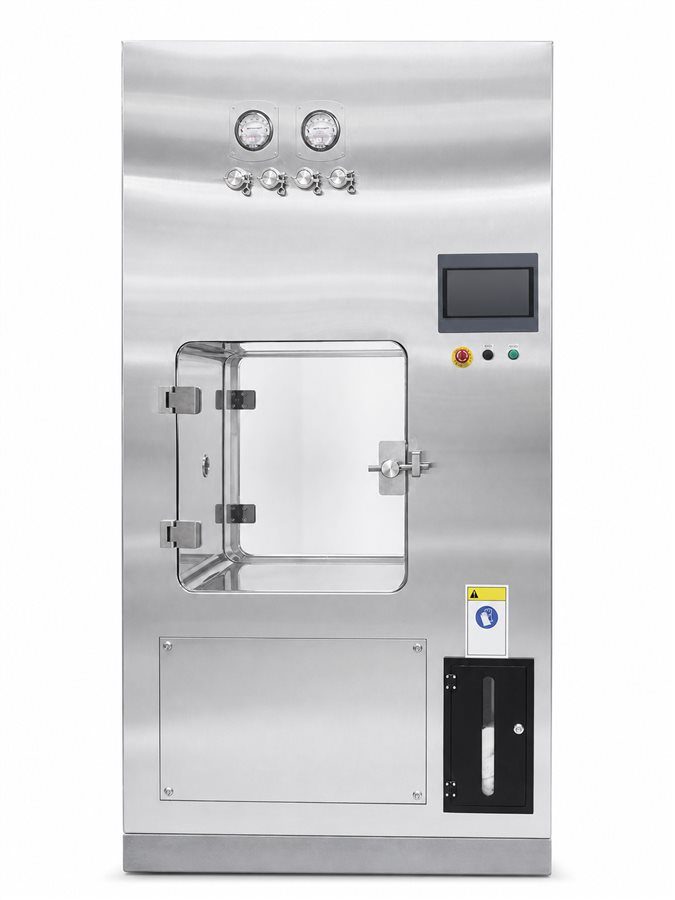
Every item that enters a Grade A/B zone is a contamination route. A VHP pass box or material airlock decontaminates the exposed surfaces of that material inside an interlocked chamber, so it can cross the boundary without breaking the pressure cascade.
Why this needs a VHP step
Materials arrive from Grade C/D areas carrying bioburden on their outer surfaces and packaging. Wiping with sporicidal agents is operator-dependent and hard to prove; autoclaving is not an option for heat-sensitive items, electronics or many single-use components.
A VHP transfer chamber replaces the manual step with an automated, recorded cycle: dehumidify, condition, decontaminate, aerate — and only then unlock the receiving-side door.
Equipment options
VHP pass box
For components, tools and sealed containers that fit a chamber. Interlocked inflatable-seal doors, H14 HEPA on inlet and outlet air, desiccant-wheel dehumidification, Siemens PLC with cycle printing.
View specifications →FG-VHP-AL250Material airlock with integrated VHP
For loads too large or heavy for a pass box — palletised packaging, equipment, environmental-monitoring kit. Runs as a normal BMS-controlled airlock between cycles.
View specifications →Key specifications
| VHP pass box (FG-PB-VHP) | Airlock VHP (FG-VHP-AL250) | |
|---|---|---|
| Process temperature | 25–35 °C | 25–35 °C |
| Process humidity | 40–60% RH | 40–60% RH |
| VHP concentration | 300–500 ppm | 300–700 ppm |
| Full cycle time | Confirmed per load | < 60 min |
| Residual after aeration | ≤ 1 ppm | ≤ 1 ppm |
| Air filtration | H14 HEPA | H14 HEPA |
| Sporicidal efficacy | ≥ 6-log (subject to validation) | ≥ 6-log (subject to validation) |
Figures from Fenggu product specifications. Cycle times and efficacy are confirmed by validation for your space and load.
What to plan for
VHP is a surface process
It decontaminates exposed surfaces. It does not penetrate sealed packaging, closed containers or mated surfaces, so the load must be presented with the surfaces you need treated actually exposed.
Cellulose and liquids are problems
Paper, cardboard and other cellulose materials absorb hydrogen peroxide, dropping the chamber concentration and extending aeration. Open liquids do the same. Plan an outer wrap or exclude them.
Load pattern is part of the validated state
Shadowed, stacked or touching surfaces are the worst cases. Define fixed load patterns, then place biological indicators at those locations during qualification.
Throughput drives chamber choice
Cycle time — not chamber size — usually limits transfers per shift. Work out how many cycles you need per day before choosing between a pass box, a larger chamber or an airlock.
Door interlocks and pressure
Both doors must never open together, and the chamber pressure must sit correctly between the two connected classifications during loading and unloading.
Information an engineer will need
Having these ready makes the first recommendation specific instead of generic.
- Largest item dimensions and weight
- Materials in the load (plastics, metals, paper, electronics)
- Transfers needed per shift
- Cleanroom grades on each side
- Data-integrity / audit-trail requirements
- Available utilities (power, compressed air, exhaust)
Common questions
Can a VHP pass box replace autoclaving?
No — they solve different problems. An autoclave sterilises items (including their interiors) with moist heat. A VHP pass box decontaminates the exposed outer surfaces of heat-sensitive items as they transfer. Many facilities use both.
How long does a pass box cycle take?
It depends on chamber volume, load, materials and the aeration target, so it is confirmed during cycle development for your load rather than quoted as a fixed number.
When should I choose an airlock instead of a pass box?
When the items are too large or heavy for a chamber, or you need to move carts or equipment. The airlock performs the same four-phase cycle at room scale.
Tell us about your application
Send the volume, materials and what you need to achieve. An engineer reviews it and replies with a recommended setup and what validation will involve.